I have written more than 100,000 words of specs in my career. I haven’t opened Word to write one in a year.
I’m still doing the same job. I still write specs, run reviews and try to get a room full of people to agree on something. What changed is where the thinking happens. It used to happen in Word. Now it happens in a conversation with an agent, and in meetings with my team. Word is where the result goes so I can share it.
How I used to work
When I took on something new, I first got the lay of the land. What’s the problem? Who has it? What does it cost them? Who has solved it before, and how? What do the stakeholders think? Today we’d call all of that context.
Then I’d go hermit. Alone with the context, I’d write, question myself, rewrite, and sometimes throw it all away and start again. The pen, or the blank page, forced structure on my thinking. Ideas reorganized themselves as I wrote them down, so by the time a thought reached the page it was sharper than when it started.
Funnily enough, I ditched Word for thinking a long time ago. The ribbon distracted me. I went from Notepad to Notepad++ to Notion, with a brief dating period with Obsidian, just so I wouldn’t spend my time fiddling with headings or worrying about a paragraph breaking across a page. But I always came back to Word to pull the spec together.
What came out was a spec. Early in my career a verbose spec ran 40 pages and a classy, to-the-point one ran 8. As I got more senior, those became 10 pages and 3-5. I’d circulate it, hold reviews, gather comments and revise until we were aligned. Then it became collateral for everything else: the design spec, the dev spec, the test spec, the decks. The original almost always went stale. The disciplined among us kept it updated. Everyone else moved on to whatever the latest slide or email said.
All of this happened in Word, Excel, PowerPoint and Outlook, and with COVID, in Teams.
How I work now
Here’s a recent project, with the specifics removed.
- Gather the context: customer feedback, old specs, Teams threads, meeting transcripts, competitor research, our design team’s Figma files. Then I talk through the problem out loud. I got hooked enough on this that I built myself an always-on voice setup: a wireless mic, local speech-to-text, and everything I say sorted into notes and to-dos on a daily Notion page. All of it goes into Copilot.
- Draft with the agent. We go back and forth until there’s a spec I’d put my name on. I’m not going to pretend it gets it right on the first prompt. It never does.
- Review with my v-team, the people actually building it. That’s a working meeting in Teams. It’s recorded, and the transcript goes straight back to the agent.
- Prototype it. The spec and the Figma files become a working HTML prototype, alternatives included.
- Rehearse the big review. I ask the agent to play each stakeholder and leader and tell me what they’ll push back on. I fix it before they see it.
- Review with stakeholders and leadership. I ask Copilot to make a 2-minute explainer video, in the 3B1B style Andrej Karpathy pointed us to, so everyone walks in caught up. Then the prototype does the persuading. That transcript goes back into the loop too.
The loop is also how I learn. A while back my director rewrote a leadership status I had drafted. Instead of just taking her edits, I turned them into rules and had an agent redraft older status reports without seeing her version. Given only her original prompt, the agent reproduced the exact framing she had rejected. With my rules added, it landed on her framing, on reports from 2 different weeks. Her 1 round of feedback became something I could reuse and test.
Written down, that looks like a lot of work. The agent does most of the heavy lifting, so I can go around the loop many times, and no draft needs to be perfect because the next round will improve it.
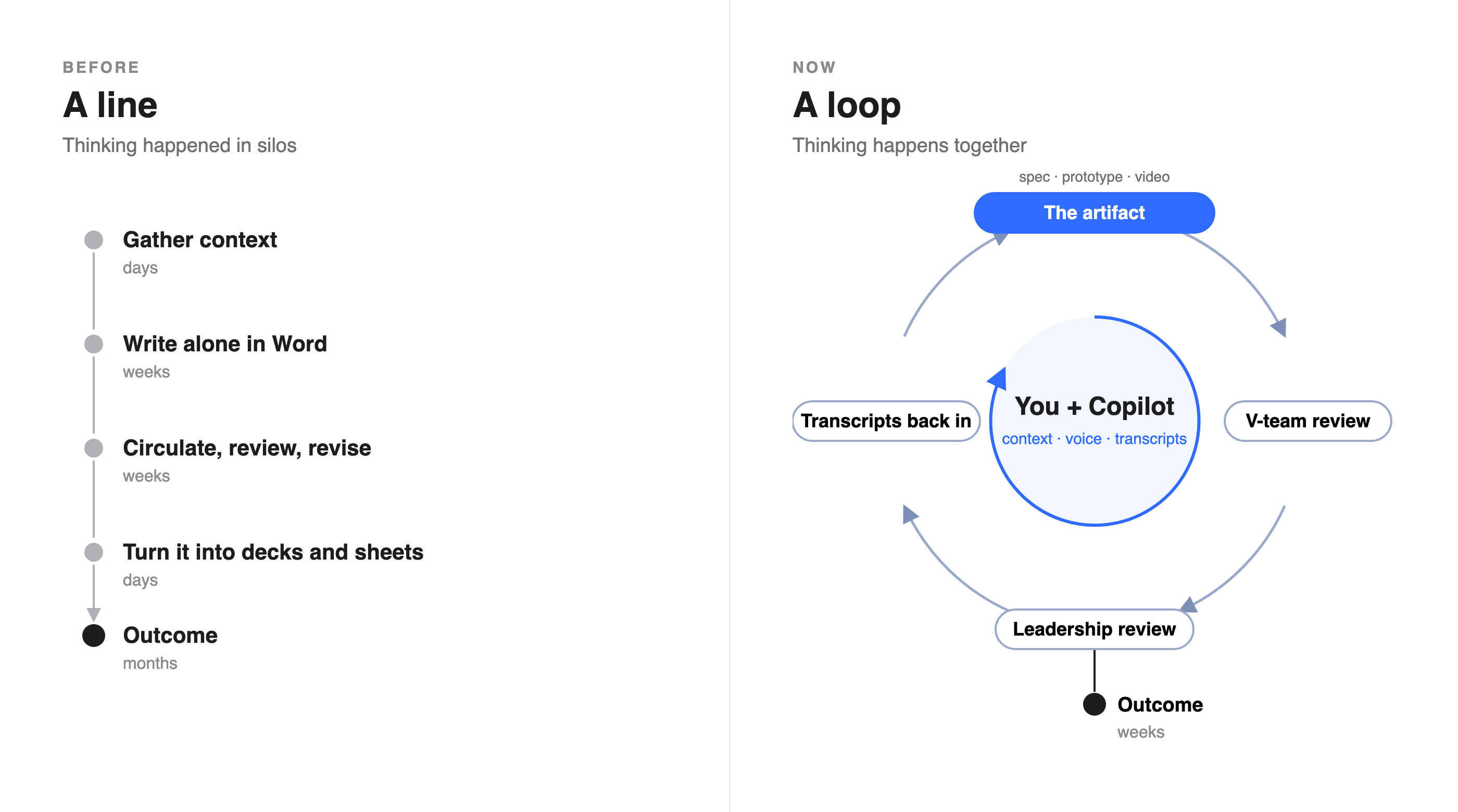
Look at where the time went. Almost none of it went into Word, Excel, PowerPoint or Outlook. I’d estimate I spend about 1% of the time in those apps that I used to. I still open them to share a version I’ve reviewed, because it carries my name. But the thinking happened in Copilot and in Teams meetings. The apps have become the format of record.
Verbose in, succinct out
Succinctness used to be the writer’s and editor’s job, done on the page.
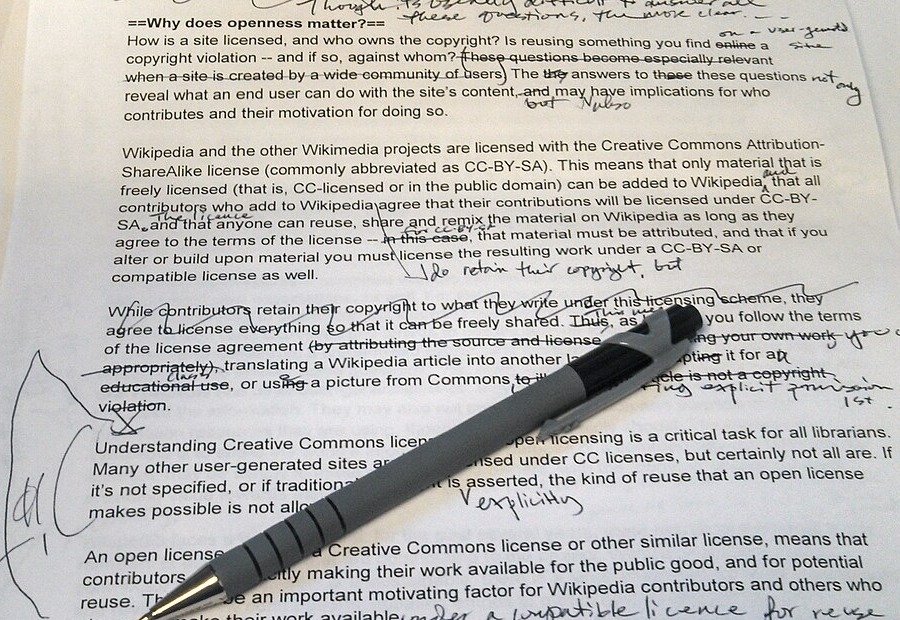 Photo: Phoebe, CC BY-SA 3.0, via Wikimedia Commons
Now my first reader is an agent, and an agent doesn’t need me to be succinct. I can ramble. It takes in a stream of half-formed thoughts and asks me the questions that force structure. The condensing happens in the back and forth, not in my head before I type.
There are legendary orators who can speak in finished paragraphs. Most of us can’t. We think in a stream of thoughts and only get succinct when we write. For the first time, that’s fine.
The room matters more, not less
I co-write the spec with an agent. My reviewers often read it through an agent’s summary. So the meeting is the one place where people actually encounter each other’s thinking directly, without a summary in between.
People not paying attention in reviews is nothing new. Every PM has presented to a room of people answering email, and no one wants to hear me drone on and on. What’s new is that I don’t have to meet that room with a 40-page document and a monologue. I can meet it with a 2-minute video and something they can click. We used to read about an idea, then talk about it. Now we experience it, then talk about it. Everyone starts from the same experience, so the conversation starts higher and better informed.
What this costs
It isn’t free, and I’d be selling something if I said it was.
The first cost is slop. When producing a document costs almost nothing, plenty of people will produce documents for nothing. I’ve seen a section of a leadership update that was mostly AI text its owner had never actually confirmed, and it nearly went out. You have to be more disciplined about what you put out, not less.
The agent also gets things wrong, confidently. While preparing a leadership review, it summarized what 2 leaders had told us, and it didn’t sound right. I asked, “is that really the feedback they gave us?” and made it go back to the meeting transcript. It had drifted. Another time it handed me dense slides when I’d asked for slides you can read in 30 seconds, and I sent them back. The agent brings speed and good prompts for my thinking. The judgment is mine, and most of what we start with, I cut.
The second cost is quieter. The more I think with an agent beside me, the less I practice thinking without one: questioning myself, sitting with a blank page. I worry about losing that.
So I’ve gone old school. I journal more, with pen and paper, where no agent can intervene. The more I think with an agent, the more I journal by hand. One is for the work. The other is so I don’t forget how to think alone.
What comes next
We used to have a word for a living document that never goes stale: the wiki. Wikis failed because nobody tended them. Agents can do that tending, taking in every transcript and decision and keeping the page current.
Some Wild Ass Guesses (SWAG):
- The default reader of a work document will be an agent. We’ll write for it with full context and let it produce the right view for each person.
- Meetings will get shorter and matter more. When agents rehearse the review in advance, live time goes to real disagreement and real commitment.
- Taste becomes the scarce skill. When anyone can produce anything, the value is in what you choose to leave out.
The document was never the work. It was a translation layer between an idea and the thing we shipped to customers. The work was always the thinking behind it and the impact after it, and that part is still on us.
I wrote this the way it describes: rambling voice notes, a lot of back and forth with an agent, and the final calls mine.